![LPP_logo-white.png]](https://information.lucypetproducts.com/hs-fs/hubfs/LPP_logo-white.png?height=40&name=LPP_logo-white.png)
What role does the immune system play in health?
The immune system is made up of a network of cells, tissues, and organs that work together to protect the body. The immune system not only affects health, but energy levels, ability to deal wth stress and more.
Having a healthy immune system means that the immune system can respond appropriately when faced with different challenges. Every day your pet’s immune system is challenged by viruses, bacteria, environmental toxins, and other pathogens. In addition, scientists believe that stress and poor nutrition can also affect immune health.
What is the microbiome?
The body contains trillions of microbes to form the microbiome, or gut flora. The microbiome is a key part of digestion, impacts immune strength and recent human health studies suggest plays a role in many more aspects including weight and mood. Prebiotics help support bacteria in the gut mircobiome which may lead to improved health.
What is the goal of good gut health?
Gut Health is about achieving balance in the digestive system.
Everything we eat or drink affects our gut bacteria diversity, and ultimately our overall health. Diets low in fiber may not create a thriving gut environment.
Prebiotic fibers help to keep it flourishing, keeping the gut health on track.
Consuming a wide variety of prebiotic fibers encourages gut bacteria diversity.
Why Prebiotics?
Prebiotics are a special class of functional food ingredients that resist digestion in the stomach and are selectively fermented in the colon (large intestine).
They are typically soluble fibers, however, other types of ingredients have been recently classified as prebiotic fibers; such as resistant starches and non-digestible sugars called oligosaccharides.
While most prebiotics are dietary fibers, many dietary fibers are not prebiotics.
Not all dietary fibers are considered prebiotics, as some aren’t fermented by the gut at all, as is typical of non-soluble fiber, or aren’t selectively fermented, meaning they feed gut bacteria.
Read more on Probiotics vs. Prebiotics for Pets.
Why is Fiber so important?
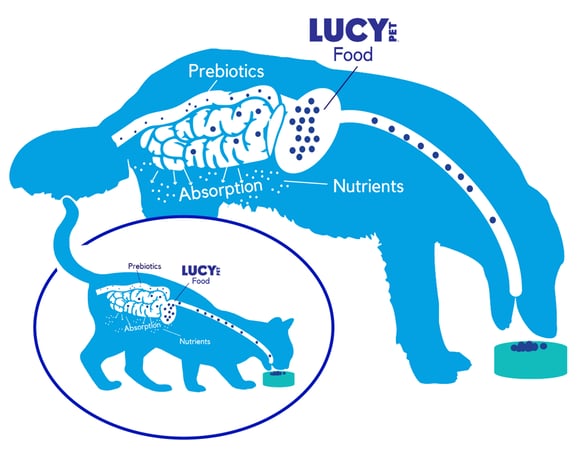
Until recently the importance of the gut in overall health wasn’t understood. Today we know that the digestive tract goes far beyond just processing the food your dog eats. That’s why we developed our Lucy Pet P.B.F. Prebiotic Balanced Fiber™.
Learn more on how Prebiotic Balanced Fiber works in the systems of dogs and cats.
We all know that fiber is important because it promotes the movement of food through the digestive system, and produces consistent stools. However, new research shows that having a variety of fibers with a precise blend can produce an optimal environment in the digestive tract to create prebiotics to perform at their peak.
Prebiotics are fermentable fibers, also known as a resistant starch. Resistant starches are dietary fibers naturally found in foods like whole grains, and legumes such as beans, lentils, and peas.
Your pet’s gastrointestinal system uses acids, enzymes, and other secretions to break down food as it passes along. As the fibers break down and ferment, they produce prebiotic bacteria. Your pet needs bacteria in the gut for a variety of reasons such as improving digestion, keeping the body healthy, and helping other systems performing. The prebiotic fiber ingredients will ultimately encourage better nutrient absorption.